
The Tipping Point
Youth Club Volleyball, Two Professional Leagues, and How Women’s Volleyball Can Become America’s First True Major Women’s Sport

This is the tipping point for women’s volleyball in America. I have been around this game my entire life. I am in it now as a dad, as a coach of coaches, as a mentor, and as an owner. I don’t want to look back in ten years and say we watched the moment happen. I want to say we helped build it.
A Volleyball Dad’s Opening
I did not come to this sport through a term sheet. I came to it the way a lot of American men of my generation did — as the little brother.
My older sister played in the 1990s and I was the kid shagging balls. One of my closest friend’s mom coached the school team, so we rode the bus with the girls like unofficial water boys and trainers. I have been in gyms that smelled like floor wax and nerves for most of my life. I just did not know then that the game I was chasing balls for would become one of the most important sports businesses in the country.
It became personal again through my daughters. Teryn Murphy is a setter at Houston Skyline in Texas, a LOVB club, and Tatiana, my middle daughter, has become a defensive specialist and is growing into the libero role. I did not manufacture that love. They fell in love with the game, and because they loved it, I paid attention the way a father pays attention. Then I started seeing what every serious operator in sports eventually sees: demand, culture, elite athletes, and a market that is still underbuilt relative to the passion already on the floor.
That is the honest origin story. The rest of this Field Note is what I see from that seat — as a former Division I and professional athlete, as a youth coach for twelve years, as someone who has mentored thousands of young athletes through our camp and foundation work, as a real estate developer for two decades, and now as Founder and Managing Partner of Synergy Sports Capital, which acquired operating rights to LOVB Salt Lake.
The Phenomenon
Pickleball and padel are having a moment because they are new, social, and easy to enter as an adult. That is a real movement. It is not the same movement.
Women's volleyball is not a fad that arrived with a celebrity influencer and a portable net. William G. Morgan invented volleyball in 1895 at the YMCA in Holyoke, Massachusetts. The United States Volleyball Association, now USA Volleyball, launched its women's division in 1949. Organized women's championship volleyball in this country is 77 years old. The sport itself has been in American gyms for 131 years. Title IX in 1972 then did what good policy sometimes does: it took a game that already existed and gave it a pipeline.
What is new is not the sport. What is new is the scale, the culture, the professional product, and the fact that girls ages 8 to 18 have chosen this game as their identity sport.
They are not defaulting into softball because that is what their mom played. They are not defaulting into cheer because that is what the Friday night lights required. They are choosing volleyball. They travel. They wear the club colors. They have the matching backpacks. There is an almost sorority-like mentality inside these clubs — belonging, standards, inside jokes, shared suffering on a Sunday morning pool-play court in a convention center. These young women feel part of something. That feeling is the most undervalued asset in American youth sports.
I love sport for youth because it teaches the thing business later charges tuition to teach. You will have good matches and you will make good plays. You will also have bad matches and you will make bad plays. The question is never whether the error comes. The question is how you bounce back before the next serve. That is entrepreneurship. That is a bad quarter. That is a deal that dies in diligence. I learned it as an athlete. I coached it for twelve years. I am watching my daughters learn it now.
Ten Stats That Explain the Adoption Wave
These are the numbers I keep on the table when someone asks whether volleyball is "having a moment" or building a market.
492,799 girls played high school volleyball in 2024-25, second only to outdoor track among girls' high school sports and ahead of soccer and basketball. NFHS recorded a 2.85 percent year-over-year increase.
Girls' high school volleyball has grown every measured year since at least 1980, except the COVID year. This is not a two-year spike. It is a 45-year climb that accelerated in the last decade.
More girls play high school volleyball than basketball in all but nine states. That reversal is the quietest big fact in American girls' sports.
USA Volleyball junior girls club registration hit a then-record 333,208 players between ages 11 and 18 as of mid-2024, up roughly 40 percent since 2013-14. Junior clubs registered with USA Volleyball nearly doubled from about 1,750 in 2004-05 to 3,880 in 2023-24.
VolleyLens tracked 47,372 girls club teams and 6,317 girls clubs in the 2025-26 season, against 4,178 boys teams. The girls game is the commercial engine.
19,810 women competed in NCAA volleyball in 2024-25, up 4% year over year and 16% over ten years. Volleyball is a near-universal women's championship sport across NCAA campuses.
1,055 NCAA institutions sponsored women's volleyball in 2025-26 projections, including 348 Division I, 288 Division II, and 419 Division III programs. Add NAIA, NJCAA, and California JC programs and the collegiate map approaches 1,900 to 2,200 women's programs nationally.
92,003 fans watched Nebraska versus Omaha at Memorial Stadium in 2023, a world record for a women's sporting event at the time. Indoor NCAA finals have since cleared 21,000. Wisconsin has averaged more than 8,600 per match and projected $2 million in ticket revenue.
NSGA estimated 11.2 million Americans played volleyball in 2025 across organized and recreational settings. Organized girls' and women's volleyball in schools and clubs alone sits in the high hundreds of thousands, and the full participating base in this country is well over a million.
Two professional indoor women's leagues now operate in the United States at the same time, LOVB and Major League Volleyball, with combined 2026 footprints of 14 teams, national television, expansion already booked for 2027, and Olympic-level rosters. That has never been true before in this sport, in this country, at this quality.
The College Map
If you want to understand why the professional product can work, start with the amateur ladder underneath it. Most emerging leagues in America are trying to invent a player pool. Volleyball already has one. About four percent of high school girls volleyball players go on to play NCAA volleyball. The pyramid was already built. We just finally put a roof on it.
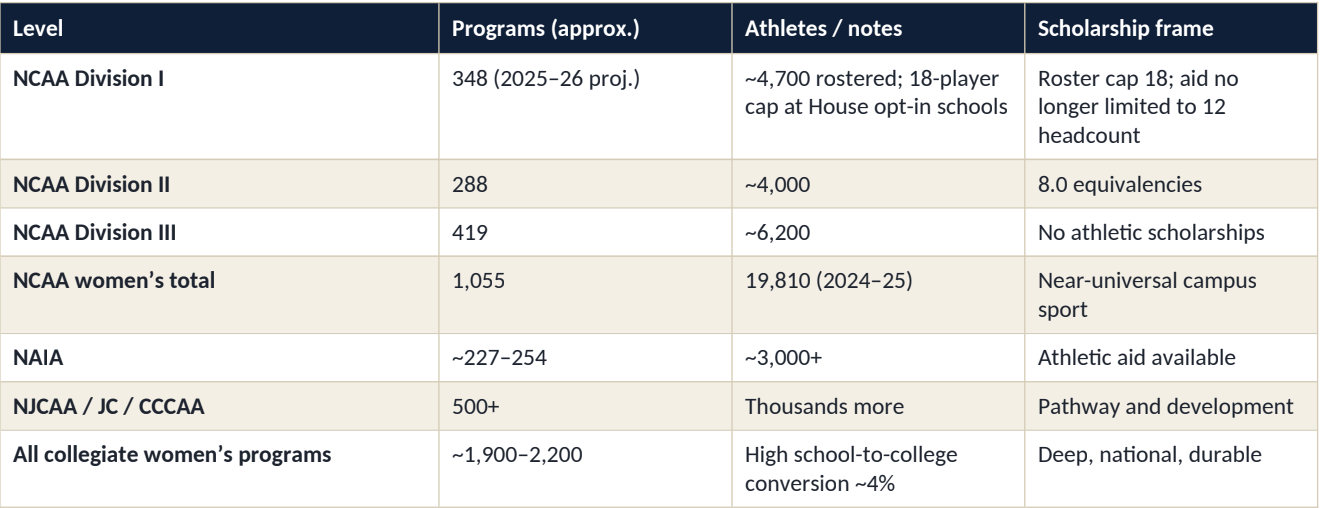
Women's volleyball collegiate infrastructure spans nearly 2,200 programs and 20,000+ athletes nationally, with a high school-to-college conversion rate of approximately 4%.
Why This Can Be the First Major Women’s Sport
I want to say this carefully, because I have enormous respect for what the WNBA, NWSL, and the new wave of women's flag football are building. Those leagues are winning. Their athletes are marketable. Their audiences are growing. I am not here to diminish any of that.
I am here to name the structural fact that almost nobody in polite sports-business conversation wants to say out loud.
The WNBA will, for the foreseeable future, live next to the NBA. That is a gift and a ceiling. The association, the arenas, the media partners, the comparison engine — it never turns off. NWSL will live next to MLS and next to the global men's club game. Women's flag football is exploding at the youth and high school level, and I have coached it, but it will still be measured against the NFL, which is the most powerful sports property on earth.
Women's indoor volleyball in America does not have that older brother in the building. Men's indoor volleyball is excellent, Olympic, and niche in the U.S. commercial market. It is not the NBA. It is not the NFL. It is not MLS. For the first time, a women's team sport in this country can be the major league of its own sport, not the sister property, not the alternative broadcast window, not the league that has to spend half its press cycle explaining why it deserves the same building.
That is the opening. That is why I believe this window matters.
Malcolm Gladwell's Tipping Point is not just a slogan. It is a description of what happens when a few connected people, a sticky product, and the right context collide. Volleyball already had the product. The athletes have always been marketable, tall, explosive, skilled, photogenic, team-first. What changed is that their stories are finally being told at scale, the youth culture organized itself into a traveling nation, and two professional leagues put a destination on the map for the girls who used to have to go overseas to keep playing.
Look at Spikes Under the Lights on August 27, 2026, at AT&T Stadium in Arlington. Nebraska, SMU, Penn State, and Florida under NFL lights. A $1 million prize pool, the largest ever awarded in women's college sports. The first major women's sporting event in that building. Live on TNT. Nebraska swept the night. Star-studded crowd. That is not a nice little exhibition. That is a sport announcing it can occupy cathedrals.
Kansas City: Proof of Demand in One Weekend
If you want the youth version of that announcement, go to Kansas City.
In February 2026, the Triple Crown National Invitational Tournament brought nearly 700 teams onto something like 100 courts across the Kansas City convention footprint. Estimates put spectators in the 30,000 to 40,000 range. Visit KC and the organizers put the economic impact near $29 million. More than a thousand college coaches walked those aisles. LOVB staged the LOVB Classic in the same city, on the same weekend, so a 14-year-old in club colors could look up from her pool-play court and see the professional game in the same zip code.
That is the model. Not a pro league hovering above a disconnected amateur world. A single weekend where the pipeline is visible.
Kansas City also hosted the 2025 NCAA Division I Women's Volleyball Championship at T-Mobile Center, more than 36,000 fans across sessions, tickets gone in minutes, a championship match that peaked at 1.7 million viewers on ESPN, and Texas A&M winning its first national title. The city has become a volleyball hub on purpose. Hubs are how sports become industries.
Two Leagues, One Rising Sport
People in our world like to force a merger narrative onto every pair of leagues. Sometimes that is right. Sometimes two well-capitalized, differently built leagues are exactly what a growing sport needs. LOVB and Major League Volleyball are taking different paths. I respect both. I put my capital and my operating team into one of them.
LOVB: Ten Things That Matter
League One Volleyball started in 2020 as a youth-club network and launched its professional league in January 2025. The idea was backwards from how most American leagues are built. Most leagues launch the show and hope the pipeline shows up. LOVB built the pipeline and then put a league on top of it.
Youth first, then pro. Founded as a club community. Professional play began January 2025. That sequence is the strategy.
On the doorstep of 100 youth clubs. From 59 clubs at the end of 2024 to 92 by May 2026, with the 100th acquisition targeted for July 2026. Locations now stretch across roughly 29 states.
An ecosystem, not just a roster of owned clubs. Owned-club athletes are in the high 20,000s to about 30,000, with 3,800-plus coaches and 2,500-plus teams. LOVB has described a broader junior ecosystem of more than 164,000 athletes, plus 500-plus youth tournaments in 2026 serving on the order of 37,500 teams and 125,000 athletes. That is how you get from a club roll-up to a national community.
Six teams now, ten in 2027. Atlanta, Austin, Houston, Madison, Nebraska, and Salt Lake City, with Los Angeles, Minnesota, San Francisco, and Miami already slated. Conferences come with that scale, East and West.
Olympic-grade talent. Roughly 80 percent of LOVB players have represented national teams. The athlete pool has carried 23 Olympic medals. About a third of the league is international. This is not a developmental circuit pretending to be a major league.
Media that is compounding, not hoping. Year-two linear inventory jumped from 10 matches to 18. USA Network's Wednesday Game of the Week averaged about 115,000 viewers, 55 percent above the prior season's mark, with a peak Atlanta-Austin match at 145,000. ESPN2 has cleared 100,000. Victory+ streaming was up 136 percent versus the prior ESPN+ window.
Serious ownership arriving. Spurs Sports & Entertainment, Lone Star Sports & Entertainment and the Texans orbit, Alexis Ohanian's Seven Seven Six in Los Angeles, a women-led San Francisco group that includes Olympian Kelsey Robinson Cook and Bay FC voices, Jordan Larson fronting Nebraska. That is not hobby capital.
Commercial proof. More than 30 partnerships in year two, including Skims, Yeti, Chase, and a league-wide CVS jersey-patch deal beginning in 2027, CVS's first volleyball sponsorship and LOVB's first league-wide on-uniform placement.
Events as a business, not a side hustle. LOVB Classic inside Triple Crown. summerLOVB activating dozens of club sites as a national celebration. Foundation camps expanding. Facilities investment already measured in the tens of millions.
A Utah flag planted. In March 2026, Synergy Sports Capital acquired operating rights to LOVB Salt Lake. That is not a logo on a cap table. That is a mandate to build a statewide ecosystem around a professional club in one of the best youth volleyball markets in America.
Major League Volleyball: Ten Things That Matter
MLV is the other pole. It is the longest-running current professional women's indoor product in the U.S., rebuilt from the Pro Volleyball Federation and the MLV combination announced in August 2025, and playing 2026 as its third recorded season under the new banner. Independently owned clubs. In-market identities. A league structure that looks like the majors on purpose.
Independently owned teams in market. That is the philosophical difference. Local owners, local buildings, local sales forces.
Eight teams in 2026, twelve targeted for 2027. Atlanta Vibe, Columbus Fury, Dallas Pulse, Grand Rapids Rise, Indy Ignite, Omaha Supernovas, Orlando Valkyries, and San Diego Mojo, with Northern California, Minnesota, Washington D.C., and additional markets already in motion.
Dallas Pulse, inaugural-season champions. On May 9, 2026, Dallas beat Omaha in five sets in front of a sellout 4,598 at Comerica Center in Frisco. A first-year club winning the title in Texas is not a small story in this sport.
Attendance that already looks like a league. More than 400,000 fans across 116 matches in 2026. Earlier PVF and MLV combined campaigns had already pushed cumulative attendance past 750,000.
Broadcast reach on traditional platforms. CBS Sports Network, CBS for the All-Star match, Roku Sports, Scripps, Vice, and Ion for the playoffs. The 2026 All-Star averaged 562,000 viewers on CBS, up 36 percent year over year. An earlier All-Star had peaked at 445,000.
Omaha as a franchise case study. The Supernovas were the gravity well of the old PVF, at one point more than a third of league attendance, and the reason the 2025 ownership fight mattered. Keeping Omaha inside a unified MLV was a league-saving event.
Ownership that looks like pro sports. Minnesota Sports & Entertainment (Wild), D.C. United partners, Vivek Ranadivé and Kerri Walsh Jennings in Northern California. Crossover from hockey, soccer, and volleyball royalty.
A commissioner with a consumer-sports brain. Jaime Weston came out of NFL marketing. That shows up in how MLV talks about itself. "This is the major leagues" is a positioning line, not an accident.
Club-level sponsorship motion. MLV sells a lot of its commercial inventory at the team level. Those deals doubled in year two. That is how you build 12 local businesses instead of one national deck.
Head-to-head markets with LOVB. Atlanta and Omaha already overlap. More overlap comes in 2027. I do not see that as a tragedy. I see two distribution systems competing to make volleyball unavoidable in American cities.
The Youth Nation
The professional leagues will get the magazine covers. The clubs are where the culture lives.
Walk a qualifier in Dallas, Salt Lake, Orlando, or Kansas City and you will see it. Ages 8 to 18. Matching backpacks lined up against a wall. Warm-up shirts. Ribbon in the hair in club colors. Parents with folding wagons and coffee. A libero who has already decided who she is. A setter talking with her hands. Girls who have been teammates for four years and will cry in a hallway when the last tournament of 18s is over.
That is not youth sports. That is a society. It has dress codes, travel rituals, status hierarchies, inside language, and a moral code about how you treat the girl next to you when she shanks a pass. People who have never stood in that hallway underestimate how durable that identity is. People who have stood in that hallway understand why volleyball does not need to borrow culture from another sport. It already has one.
Texas leads the country in club teams. California, Florida, Ohio, Illinois, and Minnesota follow. Salt Lake City is not a curiosity market. It is a volleyball market. That is one reason LOVB Salt Lake was the right club for us.
Why I Built Synergy, and Why This Is Not a Roll-Up Story
I launched Synergy Sports Capital because I could finally put everything I have built, coached, invested in, and cared about onto a single balance sheet of purpose.
I launched Synergy Sports Capital because I could finally put the whole of my life on one balance sheet of purpose.
I grew up around sports because of my older siblings. I became a Division I athlete at Texas A&M and a second-round pick of the Green Bay Packers. An injury ended the NFL chapter faster than I had planned. I did not have a blueprint after that. For twenty years I invested in real estate, venture, private equity, and businesses, building companies the hard way through development, property management, construction, and operations. I coached youth soccer, softball, flag football, and basketball for twelve years and I will own that record. I started the Terrence Murphy Camp, football, finance, and faith, and through the Terrence and Erica Murphy Foundation we have welcomed about 3,000 young people to a free camp. I have given time, sweat, and resources to thousands of young athletes, Division I athletes, and professional athletes. I serve with the Pro Athlete Community because the transition off the field is still one of the loneliest walks in American sport. I know, because I walked it.
So when we acquired LOVB Salt Lake City, I knew what some people would say. That I am rolling up clubs to make money. That a PE fund found a hot girls' sport and wrote a check.
Let me be direct: the goal is for this to be profitable. I will not insult anyone by pretending otherwise. Institutional capital that cannot return capital does not get to keep building anything. Profit is how you pay coaches, keep gyms open, fund travel scholarships, and still be here in 2036.
But if you flatten this into a roll-up, you miss fifteen-plus years of mentorship that happened when there were no cap tables or press releases. You miss the practices. You miss the foundation. You miss PAC. You miss why a volleyball dad who used to shag balls for his sister's team would care whether a 12-year-old in Utah can see a professional pathway in her own state.
We are not collecting clubs like stamps. We are trying to put infrastructure, technology, media, storytelling, and creativity underneath a sport that already outgrew the systems around it. The girls arrived first. The buildings, the broadcasts, the ownership groups, and the professional destinations are catching up.
Salt Lake City and the State We Intend to Earn
Utah is not a satellite office for me. We have land in Park City. I played in that state as a college athlete. The volleyball community there is real. Club V Sports, Club 801, high school programs that take the sport seriously, fans who already know how to fill a building when the product is right.
Owning LOVB Salt Lake means something specific. It means the professional club cannot float above the state. It has to be in the gyms. It has to know the club directors. It has to put our athletes in rooms with the girls who are wearing the backpacks. It has to treat the entire state as a home market, not a weekend destination.
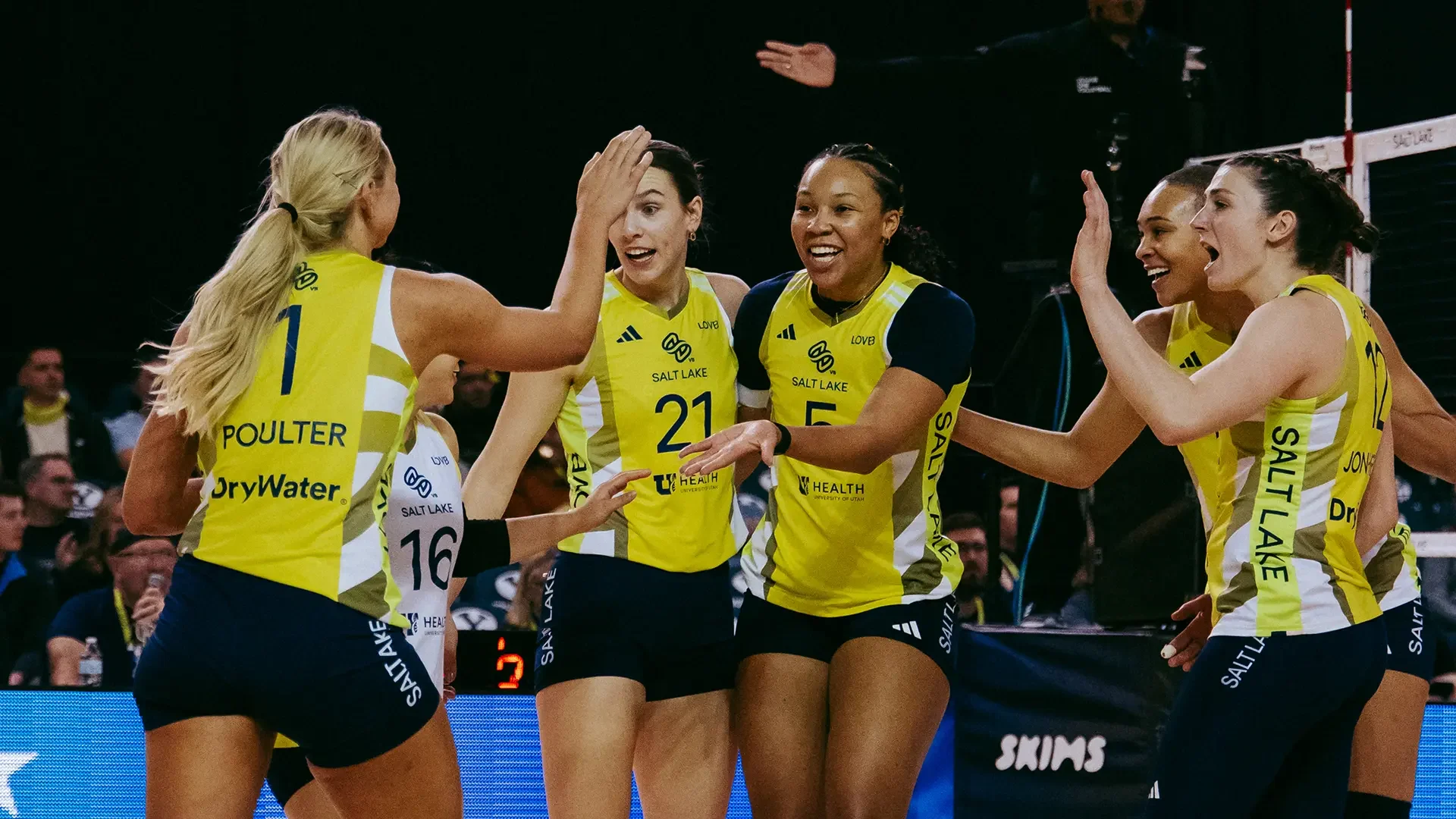
Image Source: LOVB
I have already started that work, connecting with the Utah community, pulling our players into it, listening before we announce. One day we will look back on this window the way people now look back on the early WNBA or the early MLS and argue about who understood it first. I would rather be busy than prophetic. But I do believe we will remember this as the moment women's volleyball in America stopped being a well-kept secret inside convention centers and became a major league sport.
What I Want This Fund to Put Into the Game
Infrastructure: Gyms, training centers, travel systems, and facilities that match the quality of the athletes already using them. Twenty years of real estate development is not a hobby I left behind. It is how you give a sport places to live.
Technology: Better tools for coaches, families, and fans. The club world still runs on group texts and gym-door flyers more than it should.
Media and storytelling: These athletes have always been marketable. The country is only now bothering to learn their names. That is a media failure, not an athlete failure. We can help fix it.
Creativity: Under the lights at AT&T Stadium. Triple Crown weekends that feel like a festival. summerLOVB. A professional match that a 13-year-old can reach by car. The sport does not need to become something else. It needs people willing to present what it already is.
Mentorship that does not expire when the check clears: I will measure this the same way I have measured the last fifteen years, by whether young athletes, including my own daughters, are better prepared for the next hard thing.
The Close
Volleyball has been in America since 1895. Women's championship volleyball has been organized here since 1949. High school girls have been choosing this game in record numbers for a generation. The clubs built a nation. The colleges built cathedrals. Two professional leagues finally built a destination.
I am a volleyball dad who used to shag balls. I am a former pro athlete who had to learn business without a map. I am a coach, a mentor, a developer, and now an owner of a professional club in Salt Lake City. Those are not separate identities. They are the same assignment.
The girls already decided. They packed the backpacks. They chose the sport. Our job, mine, our partners', this league's, this state's, is to be worthy of that choice.
That is the work.
Terrence Murphy Sr.
Founder & Managing Partner, Synergy Sports Capital · Operating Partner, LOVB Salt Lake
Sources:
Participation and history. NFHS High School Athletics Participation Survey, 2024–25 (492,799 girls volleyball). NCAA Sports Sponsorship and Participation Rates Report, 2024–25 (19,810 women’s volleyball athletes). NCAA 2025–26 projected sport sponsorship (348 D-I / 288 D-II / 419 D-III =1,055 programs). NCAA “Estimated probability of competing in college athletics.” Associated Press / USA Volleyball junior registration and club-count reporting, 2024. VolleyLens 2025–26 club-team census. NSGA Sports Participation in the U.S., 2026 report (2025 play year; 11.2 million volleyball participants). Britannica and USA Volleyball: William G. Morgan, Holyoke YMCA, 1895; USVBA women’s division, 1949. NCAA.com women’s volleyball attendance records.
Leagues. LOVB announcements and lovb.com, 2025–26, including the May 18, 2026 club-expansion / summerLOVB release and the March 26, 2026
LOVB Salt Lake operating-rights announcement. Sports Business Journal coverage of LOVB Season 2, media, ownership, expansion, and the CVS patch deal (January–September 2026). Youth Sports Business Report, May 19, 2026. Deseret News and Salt Lake Business Journal, March–April 2026. MLV / Pro Volleyball Federation combination release, August 5, 2025, provolleyball.com. Dallas Pulse championship release, May 9, 2026. Sports Business Journal on MLV attendance, All-Star viewership, and 2027 expansion (January and May 2026).
Events. Kansas City Star, February 2026, Triple Crown NIT and LOVB Classic. Kansas City Sports Commission, December 22, 2025, NCAA DI Women’s Volleyball Championship. NCAA.com, Dallas Morning News, VolleyballMag, and Nebraska / SMU / Penn State athletics, August 27–28, 2026, Spikes Under the Lights at AT&T Stadium.
Figures are the best available as of early September 2026 and should be dated if this Field Note is updated. Personal history, coaching, foundation, and family details are first-person.
